
High-endurance SSDs for servers and data centers
Built to handle intensive workloads with consistent performance, reliability, and low latency
Kingston SSDs deliver consistent speed, endurance, and reliability for servers, data centers, and RAID setups like QNAP NAS devices. Designed for 24/7 operations and intensive workloads, these drives offer low latency, sustained throughput, and advanced self-encrypting technology with AES 256-bit encryption and TCG Opal 2.0 compliance for secure, standardized data protection.
Available in PCIe NVMe and SATA 3.0, Kingston SSDs support cloud, virtualization, AI, HPC, and database workloads - providing scalable, high-performance, and reliable storage for a wide range of server and data center applications.
-

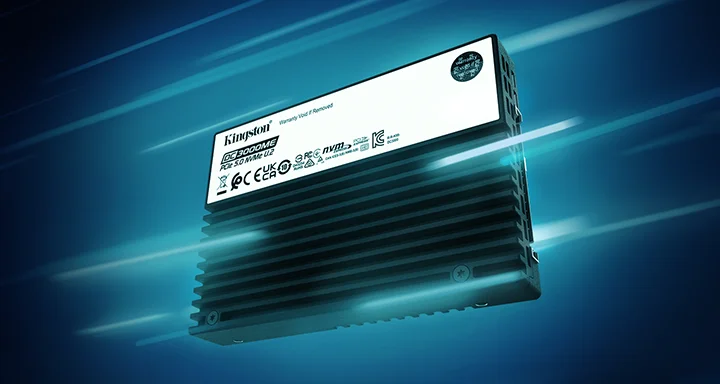
- Data Center SSD for Enterprise
- Gen5 PCIe NVMe U.2
- 3.84TB, 7.68TB, 15.36TB, 30.72TB
- Up to 14,000MB/s Read
- Up to 2,800,000 Read IOPS
-

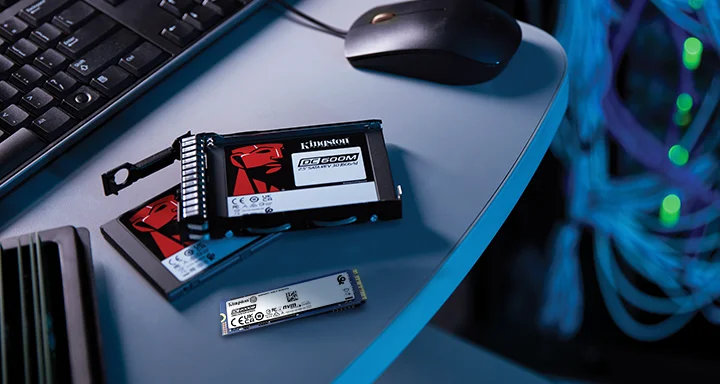
- Optimized for mixed-use applications
- 2.5" form factor
- AES 256-bit Encryption with DC600ME
- 480GB, 960GB, 1.92TB, 3.84TB, 7.68TB
- Up to 560MB/s Read, 530MB/s Write
-
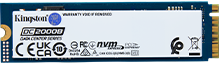
- Optimized Server Drive
- PCIe 4.0 NVMe M.2 2280 SSD
- 240GB, 480GB, 960GB
- Up to 7000 MB/s Read, 1300 MB/s Write
Key features
Reliable performance you can count on
Engineered to meet strict QoS standards, Kingston enterprise SSDs deliver predictable latency and consistent I/O performance, even under sustained, high-demand workloads.

Endurance for 24/7 workloads
With a 1 DWPD rating, Kingston data center SSDs handle continuous, mixed-use read/write operations, ensuring reliable performance for analytics, virtualization, and large-scale data processing.

Hardware-level data protection
Power loss protection, advanced error correction, and TCG Opal 2.0 self-encrypting drives with AES 256-bit encryption collectively safeguard sensitive information while minimizing downtime in mission-critical environments.

Flexible and scalable
Available in SATA and PCIe NVMe interfaces with capacities up to 15.36TB, providing the performance, flexibility, and scalability enterprises need to support growing workloads and evolving infrastructure.
QNAP technical partner
Since 2015, Kingston enterprise SSD products have been qualified to deliver speed and reliability that mitigates I/O bottlenecks, enhancing QNAP NAS systems.
Frequently asked questions
Data center or server SSDs, on the other hand, are built for constant, heavy-duty use, handling thousands of read/write cycles every day with higher endurance, reliability, and often better power-loss protection. They also typically have features like consistent low latency and advanced error correction that keep servers running smoothly under intense demand.
Essentially, consumer SSDs are about convenience and speed, while data center SSDs are about durability, reliability, and handling large-scale operations.
FAQ: Category-SSD-Data-Center-001
FAQ: Category-SSD-Data-Center-002
FAQ: Category-SSD-Data-Center-003
FAQ: Category-SSD-Data-Center-004
FAQ: Category-SSD-Data-Center-005
In contrast, consumer SSDs are designed for lighter, intermittent workloads and may struggle under continuous or intensive server operations, so it is generally not advisable to use a consumer SSD in a server environment.
FAQ: Category-SSD-Data-Center-006
TBW, or Terabytes Written, tells you roughly how much total data you can write to an SSD before it starts to wear out, so a higher TBW means the drive will last longer under heavy use. DWPD, or Drive Writes Per Day, shows how many times you could write the full capacity of the drive each day over its warranty period without exceeding its endurance rating.
Both are essentially measures of how tough the SSD is, with TBW giving the overall lifetime perspective and DWPD helping you understand if the drive can handle frequent daily writes, like in servers or video editing setups.
FAQ: Category-SSD-Data-Center-007
FAQ: Category-SSD-Data-Center-008
FAQ: Category-SSD-Data-Center-009