There are now more connected devices on Earth than there are people, forming what is known as the Internet of Things (IoT). What began as an emerging technology has now evolved into critical infrastructure, supporting industries ranging from agriculture and healthcare to manufacturing and transportation. It is also increasingly embedded in everyday life, powering smart home devices such as speakers, thermostats, wearable fitness trackers, and connected appliances.
At scale, these connected devices generate vast volumes of data, raising important questions: How quickly does data need to be processed? Where should that processing occur? What storage architecture can sustain the throughput without becoming the bottleneck? And how do cloud and edge computing work together to enable a cohesive system?
This article explains what IoT is, explores how IoT, cloud, and edge computing interact within modern architectures, highlights real-world use cases, and outlines the infrastructure and design decisions required to build scalable and resilient deployments.
What is the Internet of Things (IoT)?
The Internet of Things (IoT) refers to a network of connected physical devices, ranging from industrial equipment to everyday consumer products, that are embedded with sensors, software, and connectivity to collect and exchange data.
At its core, IoT works by capturing data from the physical world and turning it into actionable insights. Devices such as temperature sensors, smart meters, wearable fitness trackers, and connected vehicles continuously generate data about their environment, status, or usage. This data can then be processed, analyzed, and used to trigger automated actions or inform decision-making.
Once deployed, many IoT systems can operate with minimal human intervention. For example, a sensor in a manufacturing system can detect anomalies and trigger maintenance alerts, while a smart thermostat can automatically adjust temperature settings based on occupancy and usage patterns.
The value of IoT lies in enabling real-time visibility and automation at scale. By connecting devices and systems, organizations can monitor operations more closely, respond faster to changing conditions, and optimize performance across environments.
To deliver this effectively, IoT relies on a combination of devices, connectivity, processing, and storage working together as part of a broader system architecture.
IoT architecture overview
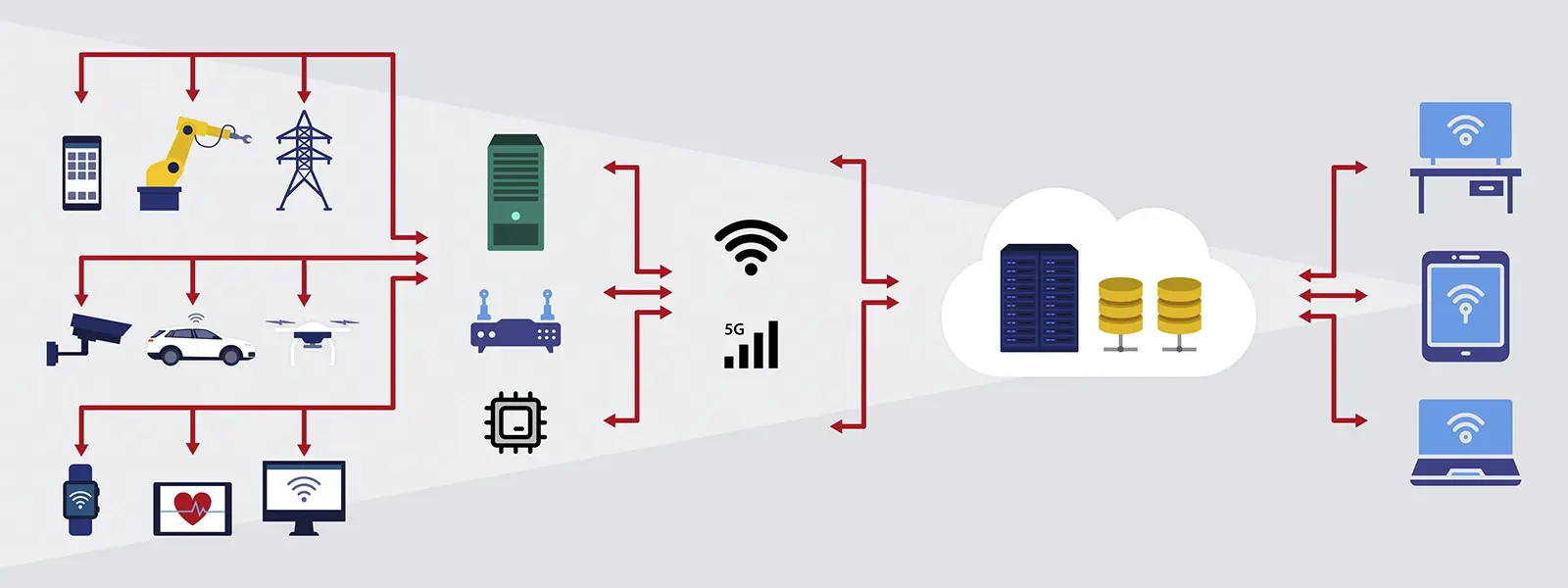
Modern IoT systems are best understood as multi-layer architectures, where each layer plays a specific role in how data is collected, processed, and used. Together, these layers form the foundation that enables IoT systems to operate efficiently at scale.
- Device layer (data generation):
This is where data is captured from the real world. Sensors and devices measure conditions such as temperature, movement, location, or usage, generating continuous data streams. Some devices may perform simple local processing before sending data onward. - Edge layer (local processing):
Where data is processed close to where it is generated. This can happen on the device itself (for example, a smartwatch processing heart rate or step count), or on nearby systems such as gateways or edge servers, enabling real-time responses and reducing the need to send all data to the cloud. - Connectivity layer (data transmission):
This is where data is transmitted between systems. This layer connects devices, edge systems, and cloud platforms, enabling continuous data flow across the architecture. It includes technologies such as Wi-Fi, LPWAN, Ethernet, and cellular networks like 4G and 5G. - Cloud layer (centralized processing & storage):
Where data is aggregated, stored, and analyzed at scale. The cloud provides the compute power and storage needed for large-scale processing, historical analysis, and system-wide management. - Application layer (insights & actions):
This is the user-facing layer where data is presented and used to deliver value. This includes dashboards, monitoring tools, automation systems, and business applications that enable decision-making.
Data typically flows through these layers in a continuous cycle, from collection and local processing through centralized analysis and action. Designing how workloads are distributed across these layers is critical to achieving the right balance of performance, cost efficiency, scalability, and reliability.