Ask an Expert
Planning the right solution requires an understanding of your project's security goals. Let Kingston's experts guide you.
Your web browser is out of date. Update your browser now for better experience on this site. https://browser-update.org/update-browser.html
Today, a remote-accessible workforce has become the norm in most industries. Employees are able to log onto company devices from home, a nearby coffee shop, or during travel at airports and hotels. While there are many benefits to a remote workforce, there is a clear cybersecurity downside: sensitive company files are put at risk while employees are on the go.
It comes as no surprise that in 2021, one of the FBI’s top five safety tips was to be mindful when connecting to a public Wi-Fi network. Unsecure internet access makes sensitive data vulnerable because hackers can monitor the data sent and received by your computer. The minute you connect to public Wi-Fi, you are putting yourself at risk of exposure to hackers and system vulnerabilities.
You might ask, what about the cloud? When a company mandates cloud storage, they don't necessarily control where you access it, making your computer or laptop a sitting duck for hackers. The cloud’s security depends entirely on the hosting provider’s technology being up-to-date and adequately protected, requiring blind trust that sensitive files will be properly secured. When there are no limits on password attempts, or a password is stolen, correctly guessed, or obtained through phishing emails, hackers can gain unfettered access to files in the cloud. In fact, cloud breaches like these have become so common that they are more expected than surprising.

While traveling to other countries, you may have to access the cloud to retrieve or upload confidential or proprietary data. But unique security policies and mandatory security restrictions from the countries your employees visit can leave you and your organization exposed.
Subjecting your data to be surveilled by non-company networks is particularly risky because foreign adversaries might use the data against organizations. With multinational corporations operating across the globe, allowing foreign governments unrestricted access to sensitive data can place unprotected companies at a competitive disadvantage, heightening the risk of industrial espionage and potentially threatening national security.
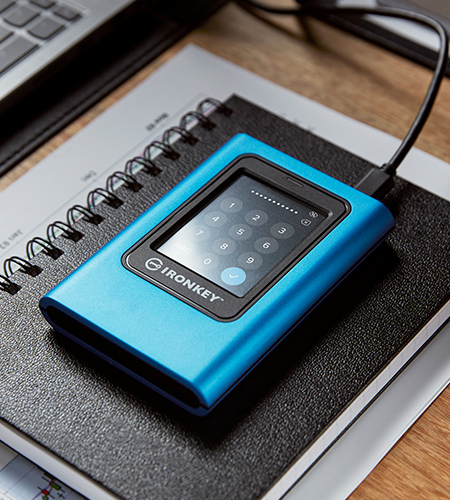
So, what can enterprise teams do when they need to travel and/or work from home? Kingston IronKey USB drives and SSDs are the best solution for remote or traveling employees who require access to sensitive company data.
The information stored on an encrypted USB drive provides travelers immediate access to their critical files while away from home or the office, meaning no risk from logging into your company's cloud using the local coffee shop, bistro, or airport’s Wi-Fi – or any other unknown Wi-Fi that could compromise your security. Instead, an encrypted USB drive is loaded with your files, which is like having the cloud continuously at your side, only invulnerable to prying eyes or would-be hackers.
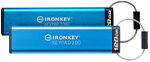
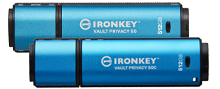
If a hardware-encrypted USB drive is lost or stolen, then the drive will permanently wipe its contents after preset incorrect password attempts. The Kingston IronKey DataTraveler Vault Privacy 50 or 50C USB Flash Drive is like an air-gapped cloud that you can access when needed, limiting your data’s exposure to the internet. For greater capacities, the IronKey Vault Privacy 80 External SSD adds up to 2TB of storage space for a secure personal cloud that is always under the employee’s control. Overall, the hardware-encrypted USB drive with Brute Force attack protection beats any cloud for protection you can control and access locally without using the internet.
With business travel comes increased risk, especially for any sensitive data held by your employees. By using Kingston IronKey products – you can rest easy and safe in the knowledge that even if drives fall into the wrong hands – your data has several layers of protection and fail-safe measures – that keep your data secured. Kingston IronKey drives offer enterprise- as well as military-grade security options for the appropriate protection level desired.
#KingstonIsWithYou
Was this helpful?
Planning the right solution requires an understanding of your project's security goals. Let Kingston's experts guide you.
For creatives producing content for high-profile clients, encrypted storage can secure your important files and help you fulfil your security responsibilities.
IronKey Vault Privacy 80 External SSD is Kingston’s first innovative OS-independent hardware-encrypted external SSD with touch screen for data protection for clients from government to finance to healthcare to legal. With military-grade encryption, IronKey offers top data security.
Learn how to use all the features of your new Kingston IronKey Vault Privacy 50, with our walkthrough. We can help you with creating user and admin passwords, enabling Read-Only or Write-Protected modes, even features like One-Time Recovery passwords.
No products match your current filter selection. Try adjusting your filters to explore more options.
Looking for improved data security & need to know what is encryption? Kingston covers the basics.
Hardware, not software-based password protection, is the best way to protect files and drives.
Discover how encrypted USB drives protect your data, and which type fits your needs.
Kingston provides advice on making your family media collection efficient and user-friendly.
Breaches remain a major threat. Explore the need of comprehensive cybersecurity measures.
Here is a list of USB security features to consider for data protection.
Learn what the 3-2-1 data backup method is and why it is your best defense against ransomware.
Learn data security best practices with Dr. Vynckier, and the importance of offline backups.
David Clarke covers encryption, superuser safeguards, vulnerability management, and training.
Learn how Kingston IronKey's solutions helped EgoMind enhance their data security hygiene.
We discuss NIS2 and DORA, and how organizations can turn compliance into an opportunity.
We discuss the shifts in how organizations are storing and encrypting sensitive data.
Kingston examines how to secure sensitive files with the increasing vulnerability of email.
Learn how Kingston IronKey hardware-encrypted solutions supports NIS2 Directive compliance.
Kingston IronKey has hardware options to protect small and medium businesses against cybercrime.
FIPS 140-3 Level 3 is certified by the world-leading agency NIST as the apex of encryption.
Our infographic showcases the differences between software and hardware-based encryption.
2023 has been a year full of challenges and innovations. But what will 2024 bring?
Learn about two methods that give SMBs superior resilience vs. ransomware: encryption & backups.
In this whitepaper, we explain how to enforce a DLP strategy, while allowing USB drive use.
Enterprise-grade and military-grade digital security: two high standards with different requirements.
We explain the meaning behind IP (ingress protection) ratings for water and dust resistance.
Learn how hardware encryption can protect a travelling lawyer’s confidentiality with secure file storage.
How is pen testing ensuring Kingston IronKey USB drives lead the way in trusted data security?
Hardware-encrypted Kingston IronKey drives protects organizations’ data on the move.
Bring Your Own Device (BYOD) policy is tricky for employers. How to balance security & convenience?
DLP offers tools for network admins to protect sensitive data from cybercrime and negligence.
A look at how the requirement of data encryption can be key to any organization's security strategy.
Invest in encrypted drives so that if they are lost or stolen you are not on the hook for legal fees which can be more expensive.
Discover why national security agencies trust Kingston IronKey to protect their data.
A company’s IT specialists should be expected to add data security to the PCs of remote workers.
Kingston’s three key practices for a robust DLP for businesses handling sensitive data.
You can read and write to an encrypted USB flash drive with an iPad or iPhone with the right adaptor. Here’s how.
Learn why hardware encryption beats software encryption for law firm data protection.
Passphrases are superior to complex passwords for keeping data secure, with many powerful benefits.
A brief explaining the purpose and types of data security software available.
HIPAA requires healthcare organizations to always keep patient data safe, including in transit.
This requires encryption of sensitive data, appointing a Security Officer, cyber security programs and policy adoption.
Kingston IronKey encrypted USBs are a security consideration for organizations of all sizes.
We compare unencrypted and encrypted USB drives and explain how to keep data secure!
Learn how Kingston IronKey is protecting the intellectual property with customization.
Discover why Kingston IronKey is the go-to solution for protecting financial services data.
Learn how Kingston IronKey is securing the military operations’ data.
How can you get your organization to use encrypted drives and make them part of your security policy? Here are some tips.
Learn how Kingston IronKey is protecting the telecoms industry's data using encryption.
Encryption is an incredibly helpful option for creatives to protect their clients’ important files.
Kingston IronKey encrypted USBs: a small but important part of any organization’s security strategy.
Kingston IronKey can help mitigate data loss resulting from the rise in lost electronic devices.
In this eBook, we explore how encrypted USB drives have become a key tool in keeping data secure.
How to use your IronKey Vault Privacy 80 External SSD: set password, connecting to a PC and more.
Organizations are considering data security options to protect against private mobile data breaches.
Discover how Kingston IronKey is protecting the sensitive data of the finance sector.
Here is how Kingston IronKey helped protect the sensitive data of the Energy industry.
We explore our KingstonCognate experts’ thoughts on cyberthreats and cybersecurity challenges.
Software based encryption can be disabled by the user. This can lead to fines and legal fees if the drive is lost.
We explore Tomasz Surdyk's thoughts on how all entities can stay secure in the digitized world.
Don’t plug any USB drives into your computer if you don’t know exactly where they came from.
Protection data on the move with superior hardware-based Advanced Encryption Standard (AES) 256.
What we learned from Kingston’s experts and tech influencers on work-from-home enablement Twitter chat.
There are benefits to using both cloud storage and hardware-based encryption.
We explore the top 12 tips small and medium size enterprises can take to enhance cybersecurity.
We’ve examined several factors using unique research to identify what may impact markets globally in 2022.
2021 has been a year full of challenges and innovations. But what will 2022 bring?
Prof. Sally Eaves shares her thoughts on the SME cybersecurity landscape and the need for education & support.
Bill Mew shares his thoughts how the largest security challenges need commitment from the boardroom.
Write your diary digitally with a password protected, cloud backup solution.
The use of DLP software, VPNs, encrypted SSDs, and USBs will help mitigate some risks of remote working.
There are many advantages to using a dedicated hardware encryption processor in USB flash drives.
What will 2021 bring in tech and trends? What do our KingstonCognate members and industry experts predict for the future?
Cyber security and data privacy are everyone’s responsibility. What are the key considerations?
Kingston & Matrix42 partnered to give optimal endpoint security solution in multiple sectors to mitigate risks.
Having a dedicated workspace, setting priorities, and eliminating distractions are just a few ways to increase productivity from home.
Organizations must consider revenue, profit, and risk equally in order to mitigate data security & cyber security risks. In this article, industry expert Bill Mew provides an insight into this topic.
What do industry experts think has changed since the introduction of GDPR?
To work from home you need a good workspace for your PC, the right conferencing gear, and a secure connection.
What strategies can organizations use to best secure customer data in a post-GDPR world with the ever-evolving nature of cyber security threats? Kingston pooled the knowledge of some of the UK’s most experienced commentators in cyber security to discuss how data protection has changed since the introduction of GDPR.
You already know that remote working is a business enabler. But the challenges posed to your network security and compliance with GDPR are too big to ignore.
The recent WannaCry ransomware made global headlines infecting and alerting everyone from government, healthcare, communication providers, automotive companies to corporations and the general public of their vulnerabilities.
Overall, Kingston / IronKey Encrypted USB Drives prove to be the best solution in reliability, compatibility and security for portable data protection solutions.
Case in point, Heathrow Airport in London (October 30, 2017) uses Unencrypted USB Drives for its non-cloud storage. Unfortunately, they were not standardized on Encrypted USB drives. Their lack of implementing proper standards in data security / data loss protection with encrypted USB storage has now cost the EU a major breach of confidential and restricted information.
Linus breaks down hardware encryption making sure your files are safe and secure, especially when you're on the go. Make sure your portable storage is also safe and encrypted with Kingston Encrypted USB drives.