Enterprise PCIe 5.0 performance
Delivers I/O consistency and low latency with sustained speeds of up to 14,000MB/s read and 2,800,000 read IOPS{{Footnote.N75936}}.
We notice you are currently visiting the UK site. Would you like to visit our main site instead?
Your web browser is out of date. Update your browser now for better experience on this site. https://browser-update.org/update-browser.html
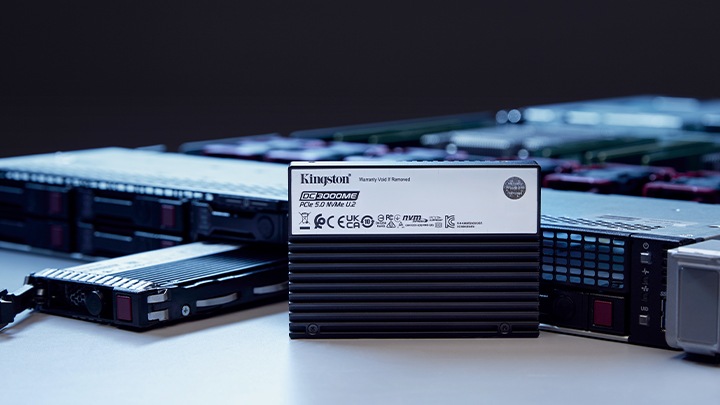
Kingston’s DC3000ME U.2 data center SSD features a high-speed PCIe 5.0 NVMe interface and utilizes 3D eTLC NAND, making it well suited for a wide range of server applications such as AI, HPC, OLTP, databases, cloud infrastructure and edge computing. DC3000ME includes on-board power loss protection to safeguard data in the event of sudden power loss and AES 256-bit encryption for ultimate data security. DC3000ME utilizes the latest high-speed PCIe 5.0 interface and is backward-compatible with PCIe 4.0 servers and backplanes. Like all of Kingston’s data center SSDs, DC3000ME is designed to deliver I/O consistency and low latency as the key design criteria that system integrators, hyperscale data centers and cloud service providers can depend on. DC3000ME is offered in 3.84TB, 7.68TB, 15.36TB and 30.72TB{{Footnote.N37130}} capacities and is backed by Kingston's legendary technical support and a 5-year limited warranty.
Applications and workloads
DC3000ME is ideal for running a wide range of server applications and workloads including:
| Form factor | U.2, 2.5” x 15mm |
| Interface | PCIe NVMe Gen5 x4 (backward compatible with Gen4) |
| Capacities{{Footnote.N37130}} | 3.84TB, 7.68TB, 15.36TB, 30.72TB |
| NAND | 3D eTLC |
| Sequential read/write{{Footnote.N75936}} | 3.84TB – 14,000MB/s / 5,800MB/s 7.68TB – 14,000MB/s / 10,000MBs 15.36TB – 14,000MB/s / 9,700MB/s 30.72TB - 14,000MB/s / 9,700MB/s |
| 4k random read/write (IOPS){{Footnote.N75936}} | 3.84TB – 2,700,000 / 300,000 7.68TB – 2,800,000 / 500,000 15.36TB – 2,700,000 / 400,000 30.72TB - 2,600,000 / 350,000 |
| Latency quality of service (QoS){{Footnote.N75936}}, {{Footnote.N47723}}, {{Footnote.N78402}} | 3.84TB-15.36TB 99% - Read/Write: <70 µs / < 10 µs 30.72TB 99% - Read/Write: <175 µs / < 12 µs |
| Static and dynamic wear levelling | Yes |
| Power loss protection (power caps) | Yes |
| Encryption | Yes - TCG Opal 2.0, AES 256-bit encryption |
| Namespace management support | Yes - 128 namespaces supported |
| Enterprise diagnostics | Telemetry, media wear, temperature, health, etc. |
| Endurance (TBW/DWPD){{Footnote.N63869}} | 3.84TB – 7,008TB, 1DWPD (5 years) 7.68TB – 14,016TB, 1DWPD (5 years) 15.36TB – 28,032TB, 1DWPD (5 years) 30.72TB - 56,064TB, 1DWPD (5 Years) |
| Power consumption | Idle(3.84TB-15.36TB): 8W Idle(30.72TB): 9W Max Read(3.84TB-15.36TB): 8.2W Max Read(30.72TB): 9.5W |
| Operating temperature | 0℃ ~ 70℃ |
| Dimensions | 100.50mm x 69.8mm x 14.8mm |
| Weight | 3.84TB – 146.2g 7.68TB – 151.3g 15.36TB – 152.3g 30.72TB - 160.5g |
| Vibration non-operating | 10G peak (10–1000Hz) |
| MTBF | 2 million hours |
| Warranty/support{{Footnote.N57503}} | Limited 5-year warranty with free technical support |
Enterprise PCIe 5.0 performance
Optimal storage and efficiency
On-board power loss protection (PLP)
AES 256-bit encryption
The DC3000ME comes with a host of features aimed at this market segment; reliability and usage statistics tracking, hardware power loss protection (PLP), telemetry monitoring, end-to-end data path protection
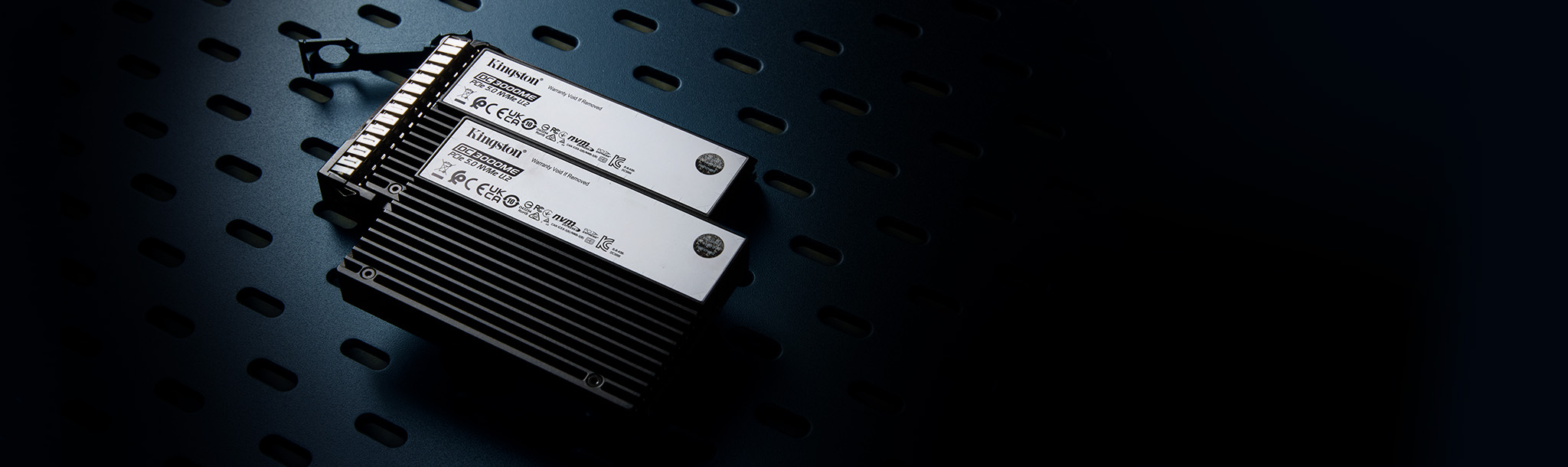
Delivers I/O consistency and low latency with sustained speeds of up to 14,000MB/s read and 2,800,000 read IOPS{{Footnote.N75936}}.
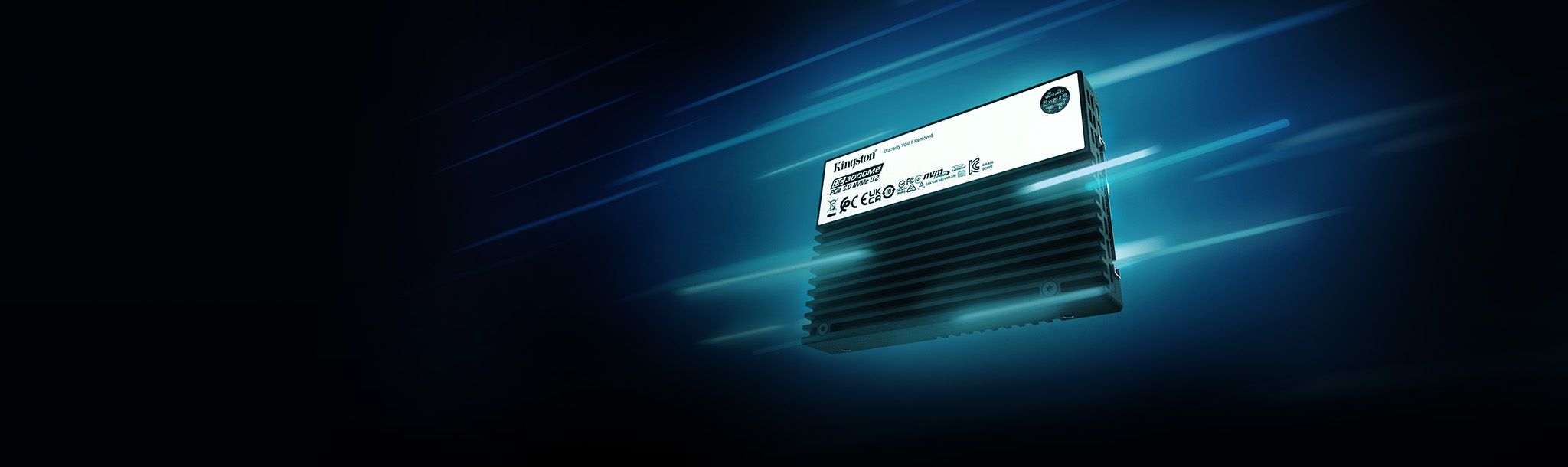
High-capacity options available offering an exceptional balance of consistent I/O delivery and ultra-high performance. Optimised to handle a wide range of server workloads efficiently.
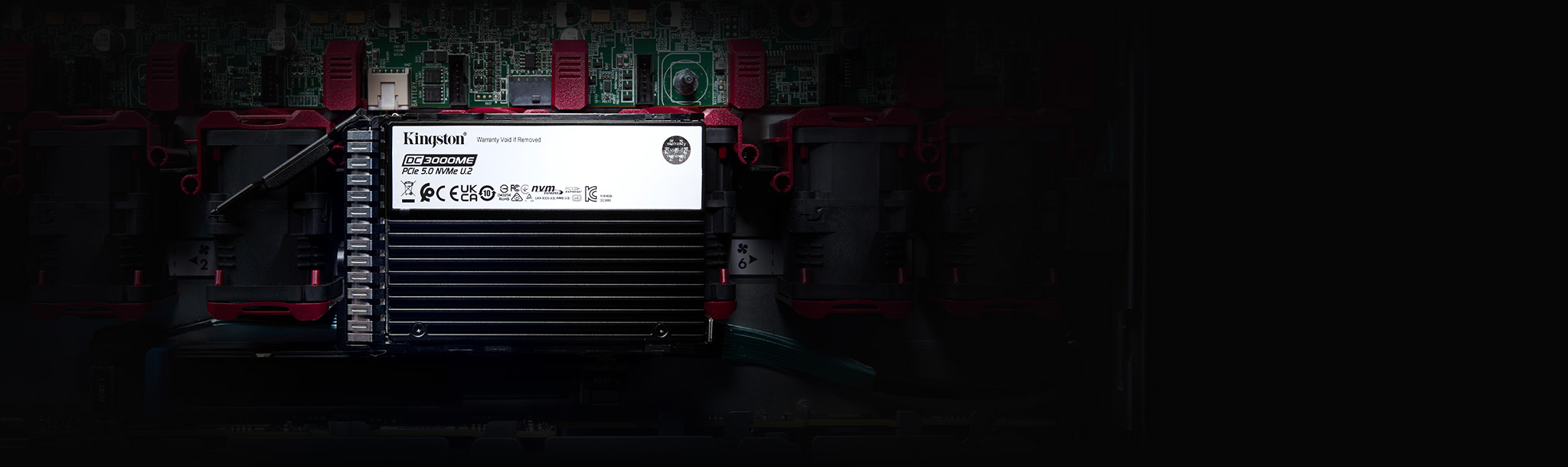
Enterprise-class protection to reduce the possibility of data loss or corruption on ungraceful power fails, including NVMe-MI 1.2b out-of-band management, end-to-end data protection and TCG Opal 2.0.

Secure sensitive data with AES 256-bit hardware-based encryption and TCG Opal 2.0.
Planning the right solution requires an understanding of your project’s security goals. Let Kingston’s experts guide you.

How power loss protection helps SSDs safeguard data during sudden power loss.
A real‑world look at modernizing server infrastructure for high‑traffic digital platforms.

SSD test beds for enterprise servers should be done with the real hardware, OS and data. We’ll explain why.
A look at how companies manage their systems when cloud computing is unavailable.
How ECC in memory and SSDs protects data integrity and reliability in server environments.
Your guide to EU data sovereignty, risks, and secure data storage strategies.
Machine learning training is resource-intensive, but how does a Kingston SSD measure up to the task?
Kingston and Taiwan Intelligent Robotics Company highlight smart manufacturing and AI, powered by Kingston’s trusted technology.
Explore how SSDs are transforming data centers with advanced technology and performance.
Learn how Kingston SSDs transformed Mission Digital’s workflow with speed and capacity.
Join Simon Bestman to explore SSD benefits over HDDs and the latest storage trends.
Reasons why a NAS would benefit your home or small office setup.
System integrators in India grew their business and reputation using Kingston’s reliable products.
Here is a list of USB security features to consider for data protection.
Learn what the 3-2-1 data backup method is and why it is your best defence against ransomware.
Simon Besteman explains the current and future challenges for data centers.
Built for disparate purposes, client SSDs and enterprise SSDs have different properties.
Learn how Terabytes Written and Drive Writes Per Day are defined, and their differences.
Read the whitepaper to learn how DC600M helps vSAN demand performance and efficiency.
Kingston and QNAP have improved the efficiency of digital cinemas with their hardware.
Questions to ask when seeking the right SSD for your organisation’s data center.
Here are some key points to help you better balance price, performance and longevity.
Elevate your data center with Kingston's VMware compatible DC600M enterprise SSDs.
We discuss the journey of digital twin technology, exploring real-world examples for success.
In this whitepaper, we explain the benefits of SDS, vs their HW and SW RAID counterparts.
In this video, we explain how Kingston and 2CRSi work together to solve data center challenges.
Learn why APLIGO chose Kingston SSD and Memory to support their system integration business.
Choosing storage products for your enterprise is a complex process. Kingston offers our expertise.
Learn how Kingston supported a leading hosting provider with optimal configuration.
Kingston examines how its DC1500M Enterprise NVMe SSD affects workloads and compares to competitors.
We explore the top 12 tips small and medium size enterprises can take to enhance cybersecurity.
This infographic is about the different types of data centers, the myths and Kingston's DC solutions.
Read our eBook, about the rise of digital transformation and what the future holds.
Bill Mew shares his thoughts how the largest security challenges need commitment from the boardroom.
Rob May shares his thoughts on how close we are to edge computing and the security it requires.
Memory and storage have evolved over the years, get an insight from our industry expert.
Learn how Kingston helped to lower power costs, increase performance so Hostmein could deliver on SLAs.
In this eBook we speak with experts about IoT’s journey and prepare organisations for IoT’s future.
The pandemic has increased internet traffic, which has placed importance on the role of data centers.
Cameron Crandall of Kingston helps you decide if you should move to your server storage to NVMe SSDs.
Join industry experts to discuss how technology partners like Kingston support their business growth and sustainability.
NVMe over Fabric helps CPUs to run more efficiently with lower latency and higher throughput.
Industry experts discuss topics like the key pillars of Tech relationships, sustainability and IT optimisation.
The switch to NVMe requires a full-stack review from IT architects to ensure redundancy exists on every layer of the stack.
In this eBook, we talk to industry experts as we explore the benefits of Artificial Intelligence, how it’s fuelling data consumption and how you can prepare your organisation for the opportunities it presents.
Here are seven of the predictions of what will drive NVMe adoption for 2021
Test SSDs to know the real endurance, changes in latency and IOPS in sequential and random read or write scenarios.
MSP industry expert Rob May’s insight into how memory/storage upgrades helps companies with remote workers.
Don’t pick the wrong type of SSD for your server. A wrong choice means a higher cost of ownership. Learn to pick the right SSDs.
Learn how Hosteur supported their rapid growth & SLAs with Kingston Enterprise products & services.
Data centres should be using server SSDs. There are many benefits over client drives and costs have come down.
NVMe is now the standard protocol for SSDs to empower data centres and enterprise environments.
Cloud and on-premise data centre managers can learn a lot from supercomputing.
SDS hasn’t lived up to its hype but now that NVMe is more affordable, the commodity hardware is ready to deliver.
Choosing the right SSD for your server is important since server SSDs are optimized to perform at a predictable latency level while client (desktop/laptop) SSDs are not. These difference result in better uptime and less lag for critical apps and services.
Industry Expert, Simon Besteman provide insight on why 5G demands edge computing in micro data centers.
Kingston delivered compatible memory that met the performance goals of i3D.net's servers, extending the service life of their existing hardware.
Why is Edge Computing Data Centers important for 5G? Download and read Kingston’s eBook on Edge Servers and the 5G rollout.

This whitepaper demonstrates how using Kingston Technology’s Data Centre DC500 SSDs can reduce your overall capital and licence costs by 39%.
Data Center 500 Series SSDs (DC500R / DC500M) – Consistency, predictability of Latency (response time) and IOPS (I/Os Per Second) performance.
A percentage of space on an SSD is reserved for OP in firmware. OP can improve performance.
Frequently asked questions around SSD technologies and terms like SATA, M.2, NAND, RAID, NVMe, PCIe, SAS, and keying.
Kingston uses LSI® SandForce®-based controllers in some SSDs that use proprietary tech for Garbage Collection.
SDS provides a policy-based control of data tiers, independent of the underlying storage hardware.
Kingston datacenter SSDs provide excellent resiliency to protect sensitive data in OLTP workloads.
HPC can require massive amounts of data. SSDs consume a fraction of the power of their spinning disk.
End-to-End Data Protection protects customer’s data as soon as it is transferred by the host system to the SSD, and then from the SSD to the host computer. All Kingston SSDs incorporate this protection.
Storage can be the most challenging component for VDI performance.
Testing is a cornerstone of our commitment to deliver the most reliable products on the market. We perform rigorous tests on all of our products during each stage of production. These tests ensure quality control throughout the entire manufacturing process.