Why NVMe Matters in the Data Center
Storage protocols are improving as organizations invest in the ongoing digital transformation that is happening in the data-heavy enterprise environment. Until now, SATA (supports SSD and spinning disk hard drives) was the dominant protocol but with the rise of non-volatile memory express, the gears are shifting towards a new kind of technology.
 Known as NVMe, the new storage protocol empowers data centers and enterprise environments to fully take advantage of high-performance flash memory. Because the SATA interface was built for hard drives, it has many inefficiencies when paired with flash memory based SSDs. While the SATA protocol is available in both SSDs and HDDs, NVMe is particularly designed for SSDs. As a result, the difference in performance between SATA and NVMe SSDs is impressive.
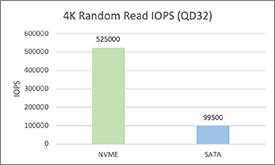
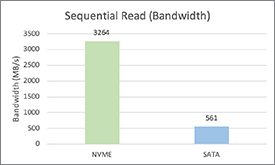
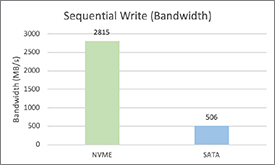
Fig. 1 above shows IOPS and bandwidth differences in SATA and NVMe
SATA III boasts speeds up to 600MB/s but is unable to sustain this kind of performance consistently. SATA based SSDs are proficient for some data center workloads since there are many legacy servers in the field that only support SATA/SAS SSDs, but they will eventually be limited and capped in their performance.
By enabling numerous I/O operations at the same time, NVMe makes possible the multicore processing necessary for organizations to compete in efficiently accessing, manipulating and processing data in enterprise environments. This Quality of Service (QoS) is what provides an exceptional balance of consistent I/O delivery with high read and write IOPS performance to manage a wide range of workloads.
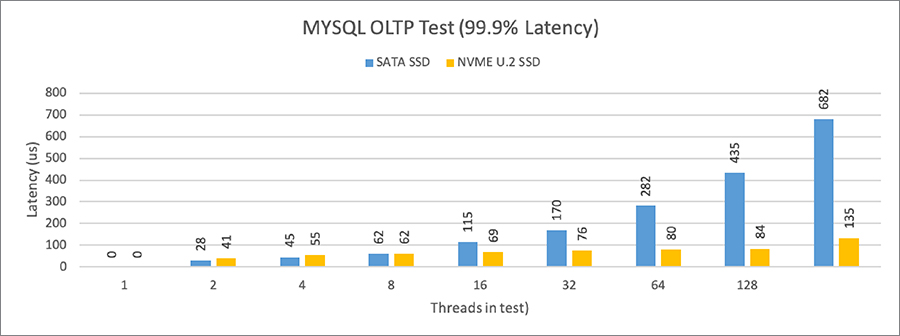
 Industries such as healthcare, finance and telecom all depend on extremely fast computers with high-performance and low latency. Healthcare and telecom companies leverage NVMe speeds for fast and complex workloads since it nearly eliminates processor wait times when reading data from storage. Finance companies use NVMe as extra storage to accelerate high amounts of transactions.
 Online transactional processes (OLTP) databases and big data benefit from high-performance reads as well. In databases, businesses can use SSD cache to pin data, metadata and indexes without slowing read speeds. This improves query speeds which ultimately improves database performance. Business analysts can make real-time decisions with fast accessible data since big data intensive workloads no longer run into bottlenecks. NVMe isn’t limited to only one specific type of workload since it improves performance for other applications as well.
 NVMe allows admins to optimize virtualized environments by increasing the number of virtual machines the virtual network can support. Usually, virtual environments need to partition the network by workload, latency or IOPS. This can lead to expensive costs and increased workload for management. NVMe is intentionally built to manage clusters and optimized performance across workloads which enables the virtual environment to boost network speed and performance without the need for complex partitions